

Think about the last thrilling game you watched. The score kept changing, and the lead shifted hands. Live betting thrives on this very uncertainty, where the odds update with every play.
At its core, this is about calculating win likelihood as an event unfolds. You don’t need a supercomputer to grasp the models behind it.
Consider the classic board game Chutes and Ladders. A game can theoretically end in just 7 rolls. In simulations, it has taken nearly 400. This shows a game’s state is inherently probabilistic its length is never fixed.
This idea connects to how machines learn. In Reinforcement Learning, an agent, like a paddle in Pong, chooses actions without knowing the immediate result. It judges value based on the total reward over the entire episode.
The same logic applies to sports. Simple frameworks tracking the score, time left, and who has possession create a powerful baseline. They help you understand the dynamic odds you see during live betting.
Build a Simple Game‑State Table (baseline WP)
Just like a video game tracks objects on screen, a sports bettor can track key metrics to estimate winning chances. This starts with a game‑state table. It’s like a structured log of every critical variable at any given moment.
This table is your baseline model for win probability. Before adding complex math, you need this fundamental reference point.
Consider a classic like Asteroids. The code defines classes for the Spaceship, Asteroids, and Bullets. Each object has properties like position and velocity.
The main game loop updates these properties every frame. The complete game state is simply the sum of all these object positions and statuses at that instant.
For a simpler simulation, like Chutes and Ladders, the state is even more basic. The only data you need to track is the player’s current square on the board. Everything else is determined by the roll of the dice.
Translating this to live sports is straightforward. You must identify the discrete “squares” for your sport. These are the variables that, when combined, define the game state.
Common key variables include:
- Score differential
- Quarter, half, or period
- Time remaining on the clock
- Down and distance (football)
- Possession and field position (basketball, soccer)
Your first model is just a table that catalogs these states. Here is a simple example for two major sports:
| Sport | Key State Variables | Example State |
|---|---|---|
| Football | Score Diff, Quarter, Time, Down, Yards to Go | +3, 4th, 2:15, 3rd & 7 |
| Basketball | Score Diff, Period, Time, Possession | -5, 3rd, 8:30, Home Team Ball |
| Soccer | Score Diff, Half, Time, Man Advantage | 0, 2nd, 70′, Even |
This table is your mental framework. It does not assign probabilities yet. It just records the situation. This baseline acts as your “position pointer” in the simulation of the live event.
With this structure, you can begin to ask historical questions. For instance, in the modeling win probability for a college basketball, the first step is defining these exact state variables.
Building your simple game‑state table forces clarity. You stop guessing and start observing the concrete conditions that influence outcomes.
Adjust for Possession/Field/Clock Context (Sport‑Specific Notes)
In-play probability changes with time and game state. Your win probability table is key, but it doesn’t consider weather, terrain, or daylight. To make good decisions, you need to add in the live context of possession, field position, and the game clock.
The idea of time decay comes from reinforcement learning. In RL, agents learn that future rewards are less valuable than immediate ones. A touchdown scored with two minutes left is much more valuable than the same touchdown with ten minutes left. This is because the opponent has less time to respond.
Think of a Markov Chain model, like tracking a player in Chutes and Ladders. After 20 rolls, the probability cloud of where they could be changes shape dramatically. Early squares become impossible, and the endgame squares dominate the possibilities. In sports, the “probability cloud” of possible game outcomes tightens and changes shape as the clock winds down. A 3-point lead with 30 seconds left is a completely different state than the same lead with 5 minutes left.
These abstract models translate directly to the field. Possession, field position, foul trouble, and the game clock act as powerful multipliers on your baseline probability. They don’t change the fundamental rules, but they dramatically adjust the odds of each possible next state. You need a system to account for them.
| Context Factor | Effect on Baseline WP | Sport-Specific Example |
|---|---|---|
| Possession | Acts as a positive or negative multiplier. Having the ball increases control over the next score event. | NBA: A team down by 2 with the ball and 24 seconds left has a much higher WP than the same team without the ball. |
| Field Position | Shortens or lengthens the path to a scoring opportunity, changing the transition probability. | NFL: A 1st & 10 at your own 20-yard line vs. at the opponent’s 30-yard line creates a different set of likely next states. |
| Game Clock | Applies time decay. Less time remaining reduces the number of possible future states, increasing the value of current advantage. | NCAA Football: A 4-point lead with 1:30 left and the opponent has no timeouts is near-certain victory. The same lead with 8:00 left is highly uncertain. |
| Foul Trouble | Alters player availability and aggression, changing the possible reward/risk of each play. | NBA: A star player with 5 fouls in the 4th quarter may play less aggressively on defense, increasing the opponent’s probability of scoring on drives. |
Look at the Game Clock row in the table. This is where time decay is most visible. With less time, the chain of possible future events gets shorter. A team’s ability to come back isn’t just a little harder; it becomes geometrically less likely with each tick. Your assessment must reflect this.
Also, Possession is key in determining the next step in the Markov chain. Who has the ball determines which team’s transition probabilities are in play. Combining possession with a short clock creates the highest-conviction scenarios. By adjusting your baseline numbers for these contexts, you move from a generic percentage to a refined, situation-aware assessment. This is how you spot the real value the moment before the oddsmakers catch up.
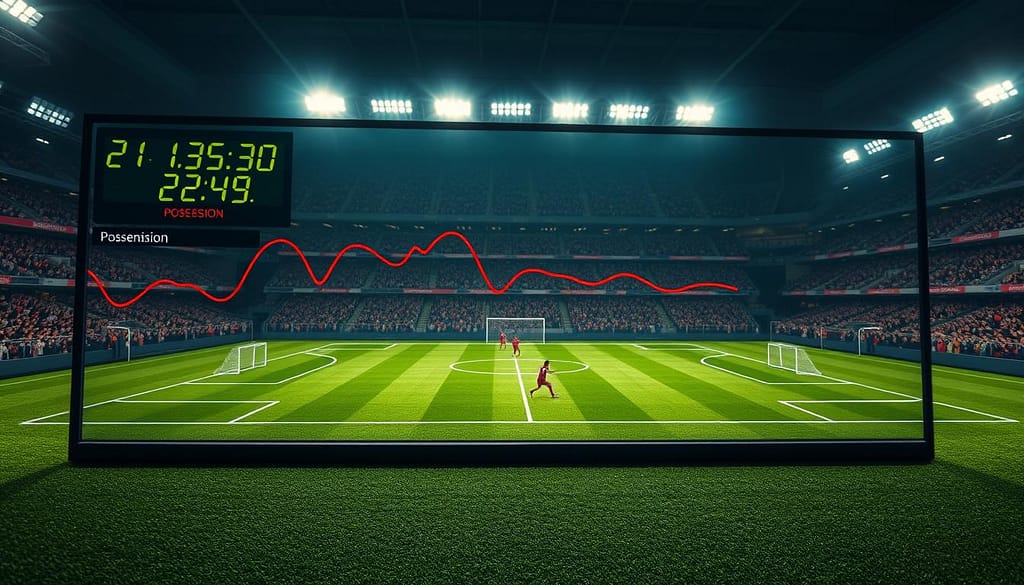
Safe Triggers Only: red cards, QB injury, foul trouble (examples)
Think of your live betting strategy as defensive code. It only responds to big failures or huge wins. This careful approach helps you avoid reckless betting.
It’s like Chutes and Ladders. A programmer stops an infinite loop if a player lands on a snake too many times. Your betting triggers should be like those snakes: big, clear events.
The “credit assignment problem” from reinforcement learning is key here. It’s hard to say what action led to a win. Was it the second-quarter timeout or a slight change in defense? We avoid these unclear areas.
Instead, look for undeniable events. These are moments where the win probability chart shows a clear change. They are the big moments in a game.
High-Conviction Trigger Examples:
- Soccer – Red Card: A straight red card, to a key player, changes the game’s dynamics and possession odds.
- NFL – Starting QB Injury: When the backup quarterback comes in, it’s a big change in offensive efficiency.
- NBA – Star Player Foul Trouble: When a key player gets a 4th foul in the 3rd quarter, it changes the game’s strategy. This is important in using advanced stats in basketball betting.
Each example shows a clear change. The win probability chart should show a big shift. Historical data shows how often these events change games. You’re betting on a known edge, not a guess.
Don’t bet on vague “momentum” or gut feel. That’s like trying to code for every small change. It’s not sustainable. The noise will overwhelm your signal.
Your rule is simple: only bet when there’s a big change in the game. Wait for events that clearly change the win probability chart. This keeps your bankroll safe and focused on real value.

Size and Exposure: micro stakes, one add max
Using the ‘ship, then bullets, then asteroids’ method helps avoid big losses. This approach, where you add features one at a time, is key for managing money. When betting live, be as careful as an engineer building a structure.
The main rule is “micro stakes, one add max”. Start with the smallest amount your bankroll allows. You can only add more once. A second signal must confirm your first idea, just like in reinforcement learning.
Small changes prevent big problems. In betting, each dollar is a parameter. A big increase can ruin your account. The Kelly Criterion calculator helps, but this rule is even safer.
Think of triggers as quality control. A red card or injury might start your bet. Adding more money needs a new, clear signal. For example, a team’s tactical change could be that second signal.
This rule keeps you safe from rare, big losses. It’s like surviving a long, unlikely game. Your goal is to keep your money safe, not to take big risks.
Here’s how to follow the “one add max” rule:
- Step 1: Start with a small stake (e.g., 1% of your bankroll).
- Step 2: Wait for the game to change.
- Step 3: Add more only if a clear new signal appears.
- Step 4: Never add more than twice. Your risk is capped.
This method makes volatility easier to handle. It’s the opposite of chasing losses or betting on a guess. For managing risk, consider hedging your sports bets as a strategy.
Your betting model should focus on steady growth, not big wins. The iterative method shows that slow, tested growth is better. Size your stakes carefully, like a developer adds features one at a time.
Post‑Game Audit: WP vs realized, lesson capture
The final step in mastering in‑play probability basics is a systematic post-game review. This audit closes the feedback loop between your predictions and reality.
Think of the Chutes and Ladders simulation. Analyzing a billion games showed different averages: the mode was 20 rolls, the median 29, and the mean 36.2. This teaches you to look at the distribution of outcomes, not just one result. Your win probability estimate is like one sample from a distribution.
After the game ends, compare your mental WP chart to what actually happened. Did the favorite’s probability dip as you expected? Did the key trigger lead to a score? This audit is not about a single bet being right or wrong.
It is about refining your model. Like a Policy Gradient algorithm in reinforcement learning, you update your internal policy. You reinforce the contextual adjustments and triggers that correlated with accurate assessments. You note which signals were false alarms.
This process of lesson capture sharpens your future judgments. Your internal “transition matrix” for game states becomes more accurate. You build a stronger foundation in the observed basics of sport, moving beyond theory. Consistent auditing makes your in‑play probability assessments more reliable and grounded.
Live Betting FAQs :
Why Do Live Betting Odds Move So Fast During a Game?
Live betting odds move because the game state is constantly changing. Every score, turnover, possession change, injury, penalty, foul, or clock situation can affect a team’s chance of winning. Oddsmakers and betting models are not only reacting to the current score. They are also estimating what the next likely sequence of events could be.
That is why a three-point lead does not always mean the same thing. A three-point lead in the first quarter is still fragile. A three-point lead with 20 seconds left and possession is a much stronger position. Live odds are essentially a running estimate of win probability based on time, score, possession, and context.
What Is Win Probability in Simple Terms?
Win probability is the estimated chance that a team will win from a specific point in the game. It is not a prediction that something will definitely happen. It is a percentage based on the current situation and similar historical outcomes.
For example, a football team leading by 10 points with five minutes left may have a high win probability, but it is not guaranteed. A turnover, injury, missed field goal, or quick touchdown can change the entire picture. Win probability helps bettors think in ranges instead of emotions.
Why Is Possession So Important in Live Betting?
Possession matters because the team with the ball usually controls the next major scoring opportunity. In basketball, a team down two with the ball late in the game is in a very different position than a team down two while defending. In football, field position and down-and-distance can dramatically change the value of possession.
Possession also affects tempo. A team with the ball can speed up, slow down, protect a lead, or create pressure. That is why possession should never be treated as a small detail. It is one of the strongest live betting signals.
What Are the Safest Triggers to Watch Before Betting Live?
The safest triggers are clear, game-changing events. These include red cards in soccer, a starting quarterback injury in football, foul trouble for a star basketball player, or a major tactical change that affects scoring chances.
The key is to avoid vague signals like “momentum” or “they look better now.” Those ideas may feel convincing, but they are difficult to measure. Strong triggers are visible, specific, and likely to change the game’s win probability.
Why Should Beginners Use Micro Stakes for In-Play Betting?
Micro stakes protect your bankroll while you learn how live markets behave. Live betting moves quickly, and emotional decisions can become expensive. By starting small, you give yourself room to make mistakes without damaging your account.
A smart rule is to place one small initial bet and allow only one additional add if a second clear signal appears. This prevents chasing losses and keeps your exposure controlled. The goal is not to win one huge bet. The goal is to build a repeatable process.
How Can You Tell If Live Odds Offer Real Value?
Live odds may offer value when your reading of the game state is sharper than the market’s reaction. For example, if a star player picks up a fourth foul and the market has not fully adjusted, there may be a short window of opportunity.
However, value does not mean simply betting because the odds look attractive. You need a reason connected to the game state. The best live betting decisions come from matching price movement with real context.
Why Is a Post-Game Audit So Important?
A post-game audit helps you separate good decisions from lucky results. You may win a bad bet or lose a smart one. The final score alone does not tell the whole story.
After each game, review what you believed at the time, what triggered your bet, how the odds moved, and what actually happened. Over time, this creates better judgment. Your goal is to improve the process, not just celebrate wins or regret losses.