
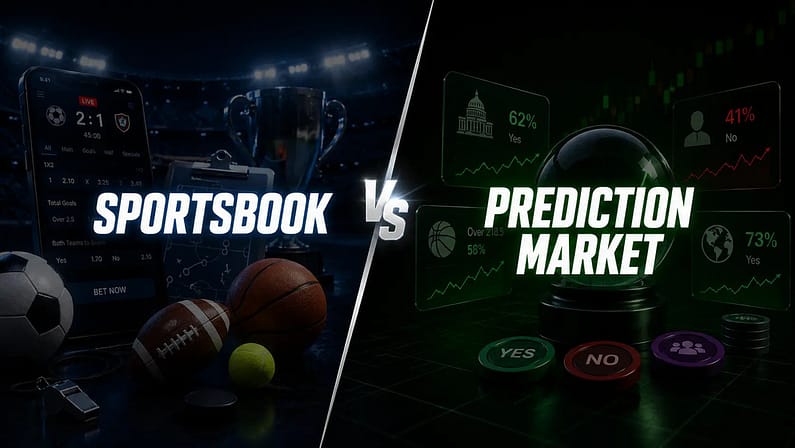
Prediction markets vs sportsbooks is no longer a niche comparison between two ways to price the same outcome. It has become a contest over who owns the bettor’s attention and who can turn every breaking event into something tradable.
For years, sportsbook competition mostly meant better bonuses, broader menus and a ranked comparison of sportsbooks. That contest still matters, but Kalshi, Polymarket and exchange-style operators such as Novig are pressuring bookmakers from a different direction: they are teaching customers to think like traders rather than ticket holders.
The New Rival Is a Different Market Model
A sportsbook posts odds, accepts the wager and manages the liability. A prediction market instead presents outcome contracts whose prices move as participants buy and sell.
The same principle behind line shopping discipline applies across both formats. Do not choose a platform because its interface looks sharper or its price is expressed in cents. Convert the terms into probability and evaluate the full cost.
That distinction changes the relationship. The sportsbook is the counterparty and builds its margin into the price. On an exchange-style market, participants trade against one another while the platform provides the marketplace and charges according to its own fee structure.
A contract trading at 62 cents resembles a 62% implied probability, just as sportsbook odds can be converted into an implied chance. The deeper difference is that the price remains tradable. A participant may close a position before settlement when liquidity is available.
Prediction Markets vs Sportsbooks Is Now a Product Fight
Price is only one battleground. Prediction markets also compete on speed, interface design and the range of moments that can become markets. They can react to politics, economics, entertainment and sports from the same account, giving customers reasons to return even when no game is starting.
Sportsbooks retain meaningful advantages. Their major-league markets are familiar, player-prop menus are extensive and same-game parlays package multiple opinions into one simple ticket.
The competition is pushing both formats toward the middle. Prediction platforms are adopting sportsbook-style sports menus, while bookmakers are borrowing trading language, live pricing and portfolio-style account features.
Four Platforms, Four Competitive Pressures
The major names are not pursuing identical strategies. Their strongest competitive pressure can be summarized this way:
| Platform | Core pressure on sportsbooks | Bettor takeaway |
|---|---|---|
| FanDuel | Combines sportsbook familiarity with event contracts | One brand can serve betting and trading demand |
| Kalshi | Uses a federally regulated exchange structure | Regulation and availability differ from state sportsbooks |
| Polymarket | Makes live public sentiment highly visible | Fast-moving prices can become part of sports consumption |
| Novig | Emphasizes exchange-style sports pricing | Liquidity matters as much as the displayed number |
FanDuel is especially revealing because an incumbent is choosing to participate rather than dismiss the category. Its expanded event-contract offering added sports, entertainment and combination contracts through Crypto.com’s derivatives infrastructure. The move signals that product overlap is accelerating, even when the regulatory structures remain different.
Loyalty and Live Betting Become Defensive Tools
Traditional operators cannot answer every new competitor by improving odds alone. A slightly better price is useful, but it may not create a lasting customer relationship. Loyalty programs, personalized offers and faster live products are designed to keep bettors inside one ecosystem.
Live betting is particularly important. Prediction markets condition users to expect prices that change continuously with new information. A sportsbook that pauses too often, posts stale numbers or takes too long to settle begins to feel less like a modern market and more like a static checkout page.
That creates pressure to improve uptime, cash-out functionality and in-game depth. It also explains why operators increasingly reward continued activity rather than relying only on acquisition bonuses. Retention is now the prize, because customers can move between betting, trading and entertainment products with little patience for friction.
Better Prices Still Require Better Judgment
Exchange language can make a market sound automatically efficient or inexpensive. Neither is guaranteed. Thin liquidity can produce wide bid-ask spreads, partial fills or a displayed price that cannot absorb a meaningful stake. Contract wording and settlement rules also create risks that traditional moneylines rarely present.
Sportsbooks have their own costs through hold and vigorish, but deep markets may offer greater certainty of execution. Serious bettors should compare the complete transaction: available price, fees, liquidity, limits, settlement terms and the ability to exit.
Regulation Will Shape the Competitive Map
Kalshi’s designated contract market status places it within a federal commodities framework, while sportsbooks operate under state gambling laws. That split affects availability, age rules, taxation, consumer protections and which authorities claim jurisdiction over sports contracts.
The decisive signals will be court rulings, state enforcement actions, exchange liquidity and whether sportsbook-led prediction products gain repeat users. Sports leagues will also influence the pace through data, media and commercial partnerships.
Prediction markets vs sportsbooks will not produce one universal winner. The more likely outcome is a blended market in which sportsbooks behave more like exchanges and prediction platforms look increasingly familiar to sports bettors. The opportunity is greater choice; the risk is mistaking novelty for value. Bettors who understand price, liquidity and settlement will be best equipped for both over many seasons.