

Do you remember that Moneyball scene where Brad Pitt’s Billy Beane outsmarted the old-school scouts? We’re bringing that data-driven magic to your betting strategy.
We’re stepping up to the big leagues, leaving gut feelings behind for hard numbers. It’s not just about numbers; it’s about finding patterns that show who’s sharp and who’s not.
Let’s dive into how Bill James’ approach turns random guesses into smart bets. We’re moving past old stats to new metrics that predict performance instead of just looking at past results.
Think of this as learning the secret language Vegas oddsmakers speak. Most people haven’t even heard of it yet.
Essential Baseball Stats for Bettors
Forget what you learned from traditional baseball cards. Batting average and RBIs aren’t as reliable as a Florida weather forecast. The real value lies in advanced metrics that show true skill.
wOBA (Weighted On-Base Average) values every hit differently. It shows a hitter’s real worth, not just home runs. It’s like judging a restaurant by taste, not just looks.
OPS+ (On-base Plus Slugging Plus) adjusts for ballpark and league factors. A 100 OPS+ is average, while 150 means a player is 50% better. It’s great for comparing hitters, like comparing poll results.
WAR (Wins Above Replacement) measures a player’s total value. Mike Trout’s 8-10 WAR seasons show why he’s valued over Triple Crown winners. It’s like measuring a country’s GDP.
BABIP (Batting Average on Balls In Play) shows luck. A .220 hitter batting .300? Check his BABIP. High BABIP means regression is coming.
Here’s how these stats help with betting:
- wOBA above .340: Elite hitter worth betting on
- OPS+ below 80: Possible betting against candidate
- WAR above 5: Franchise player affecting betting markets
- BABIP 50 points above career average: Regression candidate
These stats are your guide to player performance. They show what’s likely to happen next. In betting, that’s the key to success.
Pitching Analytics (FIP, xFIP, K/BB, etc.)
If you bet on pitchers by their ERA, you’re way behind. Welcome to the world of pitching analytics. Here, we use real metrics to find the best pitchers.
FIP – Cutting Through the Noise
Fielding Independent Pitching (FIP) is like X-ray vision for pitchers. It ignores defense and luck to show what pitchers really do. It looks at strikeouts, walks, hit-by-pitches, and home runs.
Some pitchers have great ERAs but bad FIPs. This means their stats will soon go back to normal. It’s like a fancy restaurant with bad food.
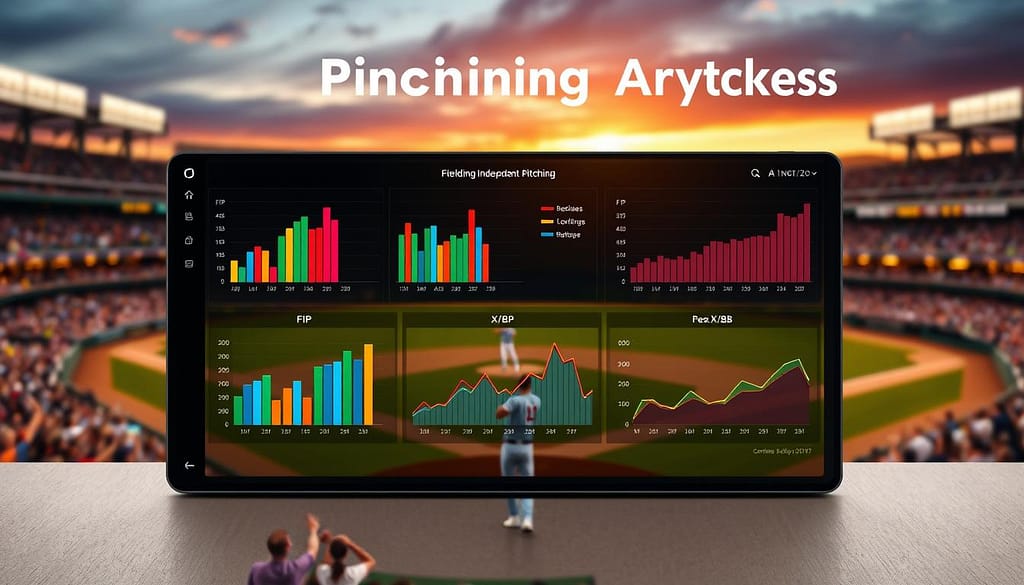
xFIP – Normalizing the Uncontrollable
Expected Fielding Independent Pitching (xFIP) improves on FIP. It adjusts for home runs, which can be affected by the weather. This makes it easier to see a pitcher’s true skill.
xFIP calculations use league-average home runs. This gives us a better view of a pitcher’s talent. It’s like comparing salaries after adjusting for inflation.
K/BB Ratio – The Pitcher’s IQ Test
The strikeout-to-walk ratio shows a pitcher’s skill. A high ratio means they control the game. They’re like chess players, while others just guess.
Here’s a simple scale:
- Elite: 4.00+ (Cy Young territory)
- Good: 3.00-3.99 (Quality starter)
- Average: 2.00-2.99 (Back-end rotation)
- Poor: Below 2.00 (Bullpen candidate)
WHIP – Measuring Baserunner Prevention
Walks plus Hits per Inning Pitched (WHIP) is old but useful. It shows how many baserunners a pitcher allows. Fewer baserunners mean fewer runs.
WHIP under 1.00 is top-notch. Between 1.00-1.25 is good. Over 1.30 is risky. More baserunners mean more runs.
These pitching analytics tools help you win. While others watch ERA, you analyze what really matters. That’s how you find the best bets.
Hitting and Bullpen Metrics
Hitting and Bullpen Metrics
While casual fans watch starting pitchers, smart bettors know games are often decided by the arms warming up in the bullpen. Bullpen metrics separate contenders from pretenders when the pressure mounts.
Reliever FIP tells you who’s getting lucky versus who’s genuinely dominant. Leverage Index reveals which pitchers thrive in high-stress situations. These numbers expose the hidden architecture of late-game drama.
At the plate, wOBA (Weighted On-Base Average) is your truth-teller. It measures overall offensive value better than traditional stats. Unlike batting average, wOBA properly weights extra-base hits.
ISO (Isolated Power) exposes warning-track power versus fence-clearing ability. Barrel Rate quantifies that perfect “thwack” sound that gives outfielders nightmares. The 2019 Twins’ record-breaking home run surge? Their Barrel Rate screamed it was coming.
These metrics provide x-ray vision into player performance. They reveal the underlying reality box scores only hint at. Smart bettors use them to spot value before the market adjusts.
Creating an Analytical Betting System
So, you’ve got all these metrics now. What’s next? Building your betting system is like putting together IKEA furniture. You have all the pieces, but you need to arrange them correctly.
Think of it as a way to make money. You don’t need to guess every game right. The real goal is to find where the market is wrong.

Let’s explore the key parts of advanced baseball betting systems that work:
- FIP vs ERA discrepancies: If a pitcher’s ERA is much better than their FIP, it’s like a sale. The market hasn’t caught up yet
- wOBA and BABIP combos: Teams hitting well but getting unlucky are ready to explode. These are your best bets
- ISO and Barrel Rates: Power hitters don’t worry about the weather. When their metrics show dominance, the odds often offer value
I built my system after the 2015 season. The Cubs’ metrics showed they were elite, but their record was mediocre. Their 2016 World Series win was very satisfying.
The secret is combining these metrics into a system. You’re not just looking for good teams. You’re finding undervalued assets. It’s like finding cheap, great wine.
Here’s how to build your advanced baseball betting strategy:
- Choose 3-5 metrics that fit your betting style
- Set values that show when to bet
- Keep track of your results – what gets measured gets managed
- Adjust your strategy based on results, not feelings
Remember, the house always has an edge. Your job is to reduce that edge with better analysis. It’s not about winning every time. It’s about winning more often than expected.
The beauty of advanced baseball betting systems? They take emotion out of betting. You’re not betting on your favorite team or chasing losses. You’re using data to make decisions.
Start small and test your system. Refine it as you go. Soon, you’ll spot value like an art expert spotting forgeries. And you’ll make money doing it.
The market will correct itself eventually. Your edge comes from seeing the problem before others do. That’s where the real advanced baseball betting profits are.
Examples from Successful Bettors
Meet the bettors who treat baseball stats like Wall Street charts. They make profits just as big.
My friend Alex used BABIP to pay for his wedding. In 2018, he saw the Red Sox had a low batting average on balls in play. But they had high hard-hit rates. While everyone worried, Alex bet on their futures.
By the World Series, he made $15,000 from a $500 investment. That’s not luck – it’s smart betting.
Billy Beane, the pioneer, didn’t bet but changed how we see hitters. He showed the value of on-base percentage over batting average. He found hidden gems in stats others ignored.
I’ve used stats to win day games after night games. When a lefty faces a weak righty, it’s like finding money. It’s all about the numbers.
These aren’t just ideas. They’re real strategies that set pros apart from amateurs. The pros see patterns and chances that others miss.
They don’t just hope for wins. They expect them, thanks to data most fans don’t see.
Continuous Strategy Development
Think you’ve cracked the baseball betting code? Think again. The analytics game moves faster than a Chapman fastball. Yesterday’s breakthrough metric is today’s baseline expectation.
Sabermetrics evolves like your phone’s operating system. Just when you master FIP, SIERA drops. When wOBA becomes comfortable, xwOBA enters the chat with its fancy launch angle and exit velocity data. Staying ahead means treating your betting strategy like a living document, not a stone tablet.
Every offseason, I add one new metric to my arsenal. It’s like downloading the latest software update for your brain. The sites that make this possible – FanGraphs, Baseball Savant, Baseball-Reference – are constantly pushing new ways to understand the game.
Remember when spin rate was obscure physics talk? Now it’s as critical as ERA for evaluating pitchers. The bettors who maintain their edge aren’t the ones with one great system. They’re the curious learners who adapt as the game evolves.
Your analytics approach needs three key elements:
- Regular metric audits (what’s relevant?)
- New data source exploration
- Strategy stress-testing against recent seasons
The beautiful part? This isn’t about finding some holy grail system. It’s about building a process of continuous improvement. This keeps you ahead of both the bookmakers and the casual bettors. The day you stop learning is the day your betting strategy becomes obsolete.
Baseball analytics waits for no one. The question isn’t whether you need to adapt, but how quickly you’ll embrace the next revolution in baseball betting intelligence.
Conclusion
Sabermetrics won’t make you a betting genius right away. It helps you understand baseball betting better. We’ve moved from simple stats like batting average to complex ones that show real performance.
The big question is not if you should use sabermetrics. It’s if you can ignore its power in today’s betting world. Old baseball stats don’t tell the whole story. Advanced metrics fill in the gaps.
Many smart people miss out on wins by chasing the idea of clutch performances. But, stats like FIP and wOBA show what really wins games and covers spreads. They don’t care about stories.
Baseball betting offers endless chances to use sabermetrics. Every game and season brings new opportunities to apply these principles. It’s all about making your betting strategy better.
When you look at a betting line, think: Are you seeing what everyone else does, or what really matters? That choice can make you a consistent winner. It shows in your betting results.