
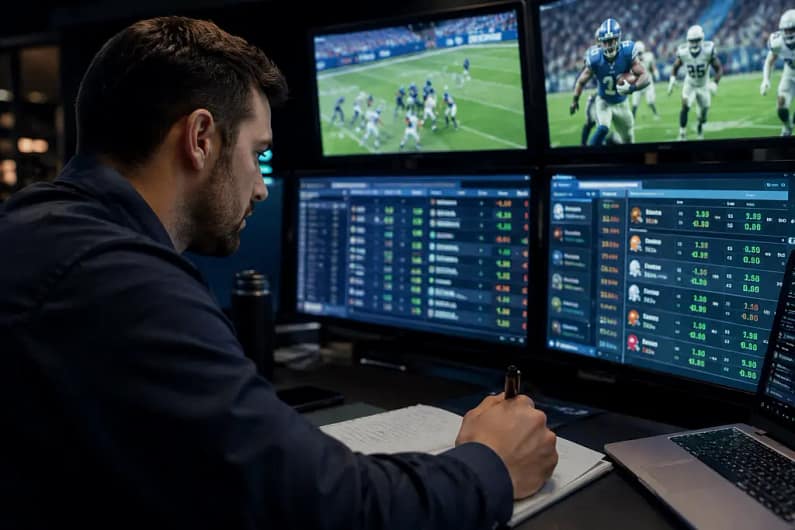
Prop bet pricing deserves a slower read than most bettors give it. A rushing total that moves three yards, a reception price that changes without the listed number moving, or a seven-yard gap between two operators can all alter the decision framework. None of that creates a wager by itself. It simply shows that NFL player props are not static products.
The cautious comparison starts with a basic question: what changed, the projection or the price? The answer matters because bettors often react to motion as if it is information on its own. In practice, movement can reflect injury updates, role signals, weather concerns, limit changes, or trading-room risk controls. It can also reflect public demand on a familiar player. Treating every move as meaningful is a psychology problem as much as a market problem.
This analysis uses reported 2026 NFL examples from earlier weeks as context. No current operator odds are quoted here, and any line or price available at a sportsbook can change before kickoff. The goal is market evaluation, not a pick sheet.
Why Prop Bet Pricing Moves Before Kickoff
Player prop markets often open before the cleanest information is available. By mid-week, injury reports, practice participation, and role expectations are clearer, but that does not freeze the board. Books may adjust lines, change juice, or pull markets when uncertainty rises.
Prop Bet Pricing Signals Versus Noise
The strongest mistake I see in prop markets is treating movement as confirmation. A line moving from 61.5 to 53.5 rushing yards may look dramatic, but the bettor still has to ask whether the new number is efficient, stale, or overcorrected. Prop bet pricing is a market conversation, not a verdict.
That distinction is central because lines and prices do not move in the same way. A book can keep a receiving prop at the same yardage while changing the over or under price. To a casual bettor, the board looks unchanged. To anyone pricing the market, the hold and implied probability may have shifted enough to matter.
Week 2 Movement As A Baseline
Across Week 2 of the 2026 NFL season, games held on September 20, 2026, Steezanomics reported that 79% of rushing yards props posted by Wednesday noon had moved by Sunday noon, often by 3 to 4 yards. The same report said receiving yards props also moved in about 79% of cases, while reception props moved far less often at the listed line level; only 16% of reception lines changed, but 175 of 196 reception lines that kept their listed number had a price change, according to Steezanomics research.
That split is useful. Yardage props may show visible line movement. Reception props may express adjustment through juice instead. A bettor who compares only the listed number misses half the market signal. This is why screenshots, bet slips, or tracking sheets should record both the line and the price, not just the player name and category.
Comparing Operators And Market Depth
Sportsbooks do not always agree on the same player. Some operators may post a higher yardage number with a softer price. Others may hold a lower line but attach less favorable juice. Without operator comparison, a bettor may think they are evaluating a projection when they are really accepting a weaker market version.
Yardage Markets Are Not The Same Product Everywhere
Week 7 of the 2026 NFL season gave several reported examples of meaningful movement before games were played. SportsBettingDime reported that J.K. Dobbins’ rushing yards prop for Denver at Arizona fell from 61.5 to 53.5, Christian McCaffrey’s combined rushing plus receiving yards for San Francisco at Atlanta moved from 112.5 to 105.5, and Josh Jacobs’ combined rushing plus receiving yards for Green Bay at Detroit rose from 56.5 to 63.5. The same report noted passing yard moves including Kyler Murray from 201.5 to 209.5, Matthew Stafford from 266.5 to 270.5, and Daniel Jones from 201.5 to 195.5, via SportsBettingDime.
Those were not small differences for prop analysis. A six- to eight-yard move can matter most near a projection cluster, especially when the market is tied to usage rather than a full-game team total. Still, a moved number should not be treated as automatically poor or automatically informative. The bettor needs a projection, a tolerance range, and awareness of whether the sportsbook has simply adjusted toward a market consensus.
Juice Changes Can Hide In Plain Sight
Market depth also affects how operators manage risk. A heavily traded quarterback passing yards market may absorb more activity before a major line adjustment. A thinner alternate receiving yards market may move faster or carry a wider hold. For related work on margin checks and behavioral guardrails, this site’s player prop pricing case study pairs well with this comparison approach.
External comparison can also help bettors understand the cost of accepting a poor price. For readers studying hold and price sensitivity beyond props, exploring low-juice sportsbook comparisons can provide a valuable perspective on the impact of pricing differences. The key insight is not just to pursue the lowest available number in isolation but to assess the comprehensive market offering.
Behavioral Risks In Fast-Moving Prop Markets
NFL player props test discipline because they blend sports information with fast feedback. A bettor sees injury chatter, fantasy projections, social posts, and line movement in the same window. That environment rewards structure and punishes impulse.
Anchoring On An Older Number
Anchoring is common in prop bet pricing. If a rushing prop opened at 61.5 and later sits at 53.5, many bettors continue thinking about the opener as the “real” number. That can distort judgment. The old line is useful history, but the available number is the only number that matters for a new decision.
The reverse problem also appears. If a bettor missed an earlier price, they may force action because they dislike feeling late. That response is emotional bookkeeping. A sound process asks whether the current line is still within a playable range under the bettor’s own model, not whether someone else got a better entry point.
Chasing Movement Without A Projection
Line movement can feel like social proof. If the market moved, someone must know something. Sometimes that is true. Sometimes the move reflects a cluster of small inputs, public pressure, or a sportsbook correcting an earlier number. Without an independent projection, the bettor cannot separate information from motion.
A practical review can stay simple:
- Record the player, market type, line, price, operator, and time checked.
- Compare at least two regulated operators available in the bettor’s jurisdiction.
- Separate line movement from price movement before judging value.
- Recheck injury and role information without treating rumors as facts.
- Decide before kickoff whether the current number still fits the projection.
This process does not remove variance. It reduces avoidable errors. That matters because NFL props are often decided by usage, game state, and coaching choices that are never fully knowable before kickoff.
Prop Bet Pricing Discipline For NFL Matchups
The most useful takeaway from 2026 examples is not that bettors should follow every move. It is that prop bet pricing varies across time, market type, and operator. Rushing and receiving yardage props may show frequent visible line changes. Reception props may hide much of the adjustment in juice. Quarterback markets can move several yards without giving a clear answer about whether the new number is strong or weak.
A Cautious Review Process
A disciplined bettor can treat each NFL matchup as a pricing exercise rather than a prediction contest. Start with the player’s expected role, then compare the current market across operators, then check whether the price has shifted enough to change the implied threshold. If the answer is unclear, passing is still a decision.
The psychological challenge is accepting that more data does not always create a better wager. More movement can create urgency. More operators can create decision fatigue. More prop categories can create the illusion that one of them must be playable. A cautious market reader does not need action on every key matchup. The better standard is whether the available line, price, and information set still support the same decision after pressure is removed.
For NFL bettors, prop bet pricing should be tracked with timestamps and compared across books before any conclusion is drawn. Lines move before kickoff, and reported historical movement should be used as context rather than instruction. The market is giving signals, but the bettor’s job is to test those signals against price, probability, and their own risk limits.