
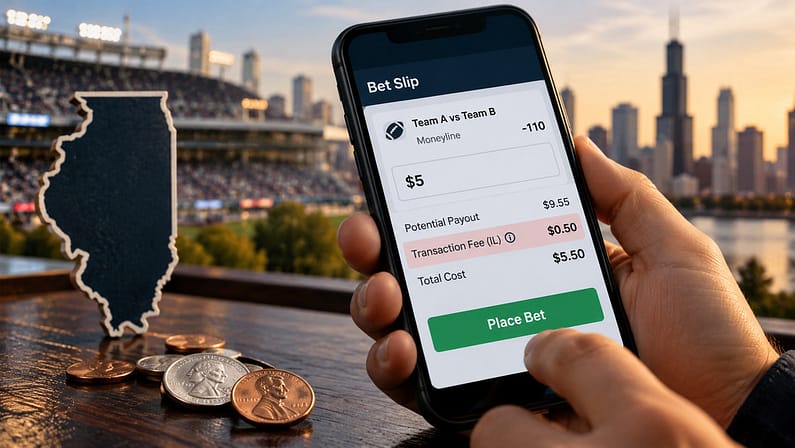
A 50-cent sportsbook charge sounds minor until the bet itself is only a few dollars.
FanDuel reinstated its 50-cent transaction fee on qualifying Illinois wagers on October 7, 2026, after pausing the charge in April. Straight bets of at least $25, parlays of at least $10, and wagers made entirely with bonus bets are currently exempt from the fee.
The important story for bettors is therefore not simply that another fee exists. It is how Illinois sports betting fees change the cost of small, frequent wagers much more than larger ones.
Illinois Taxes the Sportsbook, Not the Bettor
Illinois’ system has two separate pieces that can easily be confused.
State law imposes a per-wager tax on licensed sportsbook operators for internet and mobile bets. The first 20 million wagers accepted during a fiscal year are taxed at 25 cents each; wagers beyond that threshold are taxed at 50 cents. The tax is based on the number of individual wagers and applies regardless of whether those bets eventually win or lose.
The Illinois Sports Wagering Act makes the sportsbook licensee responsible for that tax.
FanDuel’s 50-cent customer charge is different. It is an operator-imposed transaction fee designed in response to the state’s tax structure, rather than a state tax collected directly from the bettor. Flutter originally announced the customer fee in 2025 after Illinois adopted the per-wager levy.
That distinction matters when evaluating what actually appears on a bet slip.
Why Illinois Sports Betting Fees Hit Small Bets Harder
Because FanDuel’s charge is a flat amount rather than a percentage, its relative impact falls as stake size rises.
For qualifying straight bets below the current $25 exemption, the difference is easy to see:
| Straight-bet stake | FanDuel fee | Fee as % of stake |
|---|---|---|
| $1 | $0.50 | 50% |
| $5 | $0.50 | 10% |
| $10 | $0.50 | 5% |
| $20 | $0.50 | 2.5% |
| $24.99 | $0.50 | About 2% |
| $25 | Exempt | 0% |
The calculation does not say anything about whether the wager will win. It simply measures the transaction charge against the amount being risked.
For a bettor making $100 wagers, 50 cents would be economically small even without an exemption. For someone making $2 or $5 straight bets, the same flat amount is a substantial additional cost.
That is why describing the policy as “only 50 cents” can be misleading.
Bet Frequency Can Matter as Much as Bet Size
A flat per-ticket charge also changes the economics of frequent betting.
Consider a bettor making ten qualifying $5 straight bets. The stakes total $50, but ten separate 50-cent charges add another $5 in transaction fees.
Make 100 qualifying bets at the same size and the fees total $50.
This is especially relevant in modern betting menus filled with player props, live markets and other opportunities to place several separate wagers during one game. Illinois’ state tax itself is based on wager count, which means high-volume activity creates costs for an operator even when individual stakes are small.
The practical response should not be to make larger bets merely to cross an exemption threshold. Increasing a $10 straight wager to $25 to avoid a 50-cent fee adds considerably more money at risk than the amount being saved.
Fee avoidance and bankroll management are different decisions.
Line Shopping Now Means Comparing More Than Odds
Bettors normally think of sportsbook comparison in terms of price: -105 versus -110, for example, or a better spread at one operator than another.
A transaction fee creates another variable.
The best available wager may depend on the quoted odds, the actual line, any applicable transaction charge and the amount being staked. A slightly better moneyline can lose some of its advantage if an extra fee applies to the ticket.
That extends the same cost-control principle behind comparing sportsbook price differences. The goal is not to identify one sportsbook as permanently cheaper. Prices, markets and policies differ, so the comparison has to happen at the wager level.
For Illinois bettors, the checklist is increasingly:
price + line + fee + stake size
rather than price alone.
The Exemption Threshold Should Not Set Your Stake
FanDuel’s current structure creates an obvious temptation. If a $24 straight bet carries a fee while a $25 bet does not, increasing the stake by one dollar appears cheaper.
But the same logic becomes less sensible farther below the threshold.
A person who normally risks $5 should not treat $25 as the new appropriate stake simply because it avoids a 50-cent charge. The fee would be eliminated, but the money at risk would increase fivefold.
The same caution applies to parlays. Current reporting says qualifying parlays of $10 or more avoid FanDuel’s transaction fee, but a fee exemption does not make a multi-leg wager inherently better value. The wager still needs to be judged on its own pricing and risk.
The more useful approach is to decide the stake first, then compare the total cost among regulated options available in Illinois.
The Real Cost Is the Repeated Cost
The return of FanDuel’s Illinois transaction fee shows why small betting costs deserve more attention than their dollar amount suggests.
Illinois charges operators according to how many mobile and internet wagers they accept. FanDuel, in turn, has chosen to charge customers 50 cents on certain wagers while exempting larger straight bets, qualifying parlays and bonus-bet wagers. The current FanDuel fee structure therefore has its greatest relative impact on bettors who prefer small straight bets.
One 50-cent fee may be forgettable. Fifty or a hundred of them are not.
For bettors, that makes transaction fees worth tracking alongside vig and accepted price. The useful goal is not to wager more to escape a charge. It is to know the complete cost of the wager before placing it.