
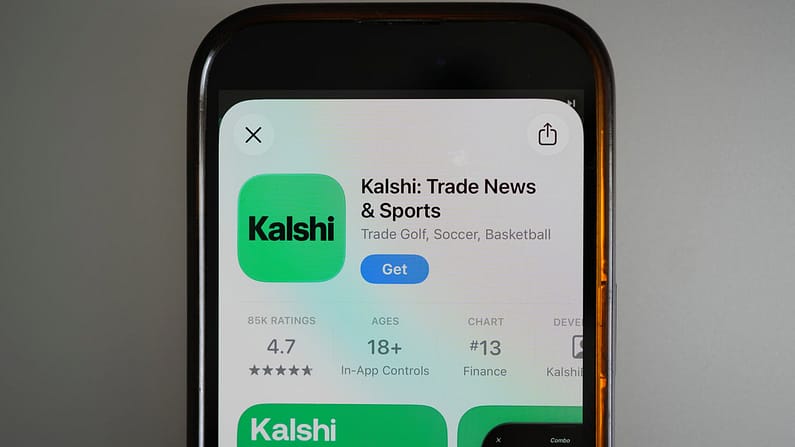
Prediction market settlement rules usually attract little attention until a market gets the winner wrong. Kalshi’s handling of the September 5 Western Michigan–Michigan game turned an extraordinary college football finish into a practical lesson about what traders are really trusting when they buy an event contract.
The episode is also a reminder that evaluating a wagering platform should go beyond price and interface. Even when bettors use a Heritage Sports betting app rating to assess a conventional sportsbook, grading policies, data sources and dispute procedures deserve attention alongside usability and odds.
One Second Turned a Finished Market Back Into a Live Event
Michigan appeared to lose 12-7 when quarterback Bryce Underwood’s desperation pass fell incomplete and the clock showed zero. After review, officials determined that a Western Michigan player who had established himself out of bounds touched the ball while one second remained.
That makes skills such as understanding implied probability basics useful. Yet even excellent probability analysis cannot protect a trader who misunderstands the contract’s resolution conditions.
Michigan received another snap. Underwood then connected with JJ Buchanan for a 47-yard touchdown, producing a 13-12 Michigan victory. The dramatic final sequence became even more consequential for traders because Kalshi had already treated Western Michigan as the winner.
Kalshi confirmed that it prematurely settled the market, which generated about $18.6 million in trading volume. The exchange reversed the incorrect payouts, restored funds to participants initially treated as losers and ultimately paid the Michigan side.
For a trading platform, that is not a minor scoreboard correction. Settlement changes ownership of money.
Prediction Market Settlement Rules Are Part of the Trade
A prediction contract may look simple: buy an outcome, wait for the result and receive the payout if correct. The difficult part is defining exactly when that result becomes official.
That hierarchy matters. Television graphics, social media posts, score apps and even an apparently expired game clock are not necessarily the governing source.
A trader therefore has two questions to answer: “What do I think will happen?” and “What exactly counts as happening under this contract?”
The second can be just as expensive as the first.
Sportsbooks and Prediction Markets Handle Grading Differently
Both products need a reliable way to decide winners, but the mechanics are not identical.
| Settlement issue | Traditional sportsbook | Prediction market |
|---|---|---|
| Governing document | House and market rules | Contract and exchange rules |
| Result source | League or approved data provider | Defined source agency or criteria |
| Payout process | Bet is graded win, loss or void | Contract settles at defined value |
| Corrected result | May trigger regrading under rules | May require settlement reversal |
| Early exit | Cash-out may be offered | Position may be sold before closing |
The critical similarity is rules outrank assumptions. Seeing an outcome on a screen does not guarantee that it satisfies the platform’s settlement standard.
Price Analysis Cannot Fix a Bad Settlement Assumption
Prediction markets invite traders to focus on probabilities. A 60-cent contract can be interpreted as roughly a 60% market-implied chance before accounting for trading costs and market structure.
Suppose you accurately estimate that a team has a 55% chance to win and buy at an attractive price. Your mathematical edge means little if you assumed the television result controls while the contract specifies another official source or a particular determination window.
Settlement risk sits outside handicapping. It belongs to operational due diligence.
Reversals Create More Than a Customer-Service Problem
The Michigan incident also exposed what happens once an incorrect result reaches account balances.
A premature determination can create a chain reaction. Winning contracts are credited, traders see additional available cash, and some may immediately allocate that money elsewhere. Reversing the result means unwinding a financial state that users were briefly told was final.
That is why faster settlement is not automatically better. Traders naturally want immediate payouts, particularly in sports markets, but a platform that waits several minutes for an authoritative confirmation may provide more value than one that settles instantly and has to reverse itself.
Accuracy should beat speed when the underlying event remains subject to official review.
Kalshi says most markets settle after the official outcome is confirmed and its markets team finalizes the result. Its market settlement guidance also explains that settlement can be delayed while the exchange waits for official data and that individual market rules identify relevant source agencies and determination criteria.
The Next Test Is How Exchanges Define “Final”
The most useful signal after the Michigan error will not be whether another bizarre Hail Mary occurs. It will be whether prediction exchanges tighten their settlement triggers, increase waiting periods for review-sensitive events or make the controlling source more prominent before users trade.
Football offers obvious trouble spots: replay reviews, clock corrections, penalties after apparent final plays and statistical changes. Other sports bring their own complications, from suspended games to scoring corrections and disqualifications.
As sports event contracts attract more volume, settlement infrastructure becomes part of the product rather than invisible plumbing.
The Michigan episode ultimately offers a simple lesson about prediction market settlement rules: traders should know not only what they are buying, but who decides the outcome and when. A sharp price can create an edge; reliable settlement is what makes that edge collectable.