

For the analytical bettor, finding winners is only half the battle. The real challenge lies in managing your money. A sophisticated staking strategy is often more critical for long-term success than just being right.
Every bet has two forces: its expected value and its variance. Even with a positive edge, the range of possible outcomes for your bankroll is vast. A string of poor luck can lead to prolonged drawdowns.
Imagine two bettors with the same proven edge. Their financial results could be wildly different based solely on how they size their bets. This spread of possible outcomes is your bankroll growth distribution.
Methods like percentage-based betting amplify this effect. They create an asymmetric risk where losses hurt more than gains help. Every strategy involves a fundamental trade-off between growth and the risk of ruin.
Understanding this trade-off is the first step. Let’s examine how different plans—Flat, Percentage Stake, and Fractional Kelly—attempt to navigate it.
Flat vs % Staking: pros/cons with scenarios
There are two main staking plans: flat betting and percentage staking. Your choice affects your bankroll’s journey. It impacts your risk, growth, and emotions.
Let’s explore each method, its benefits, drawbacks, and when it’s best to use.
Flat Staking: The Steady-Eddie Approach
Flat staking means betting the same amount every time. For example, always betting $20. This is about keeping discipline with your bankroll management.
The Pros:
- Simplicity & Discipline: It’s easy to follow. No complex math means less emotional decision-making.
- Lower Variance: Your bankroll swings are milder. Studies show flat staking has a narrower range of outcomes and lower loss probability.
- Easier Recovery: After losing, each win brings back a fixed amount. This makes getting back on track predictable and less stressful.
The Cons:
- Suboptimal Growth: During winning streaks, you miss out on compounding profits. You leave money on the table by not increasing stakes as your bankroll grows.
- No Automatic Scaling: It doesn’t adjust to your bankroll’s size. This can be inefficient for long-term wealth building.
Percentage staking means betting a fixed percentage of your bankroll. If you have $1,000 and use a 2% stake, your first bet is $20. If you win, your bankroll grows, and your next stake is 2% of the new amount.
The Pros:
- Automatic Compounding: This is its superpower. Wins automatically increase your future stakes, accelerating growth during positive runs.
- Theoretically Optimal: It aligns with mathematical models for long-term capital growth, famously linked to the Kelly Criterion.
- Built-In Down Protection: During losing streaks, your stakes automatically get smaller. This helps preserve your bankroll.
The Cons:
- Higher Volatility: The bankroll path is wilder. The same data that shows flat betting has an 18% probability of loss might show percentage staking with a 34% probability of loss over an identical bet series.
- Prolonged Drawdowns: While stakes shrink on losses, recovering to your original bankroll requires a longer winning percentage because you’re betting smaller amounts.
- Emotional Challenge: Seeing your stake amount drop significantly after losses can be psychologically difficult. It might tempt you to abandon the plan.
Side-by-Side Comparison
| Feature | Flat Staking | Percentage Staking |
|---|---|---|
| Core Rule | Bet a constant dollar amount. | Bet a fixed % of current bankroll. |
| Key Advantage | Predictability, lower risk of ruin. | Capitalizes on hot streaks, compounds gains. |
| Main Drawback | Misses growth during wins. | Higher volatility, steeper emotional swings. |
| Best For | Beginners, bettors prioritizing survival, those with smaller edges. | Confident bettors with proven edges, those focused on max long-term growth. |
| Bankroll Path | Steady, linear climbs and declines. | Exponential growth or decline. |
Putting It Into a Scenario
Imagine a bettor with a $1,000 bankroll and a 2% true edge on standard -110 wagers. Over 100 bets, the outcomes differ starkly.
With flat $20 stakes, the final bankroll likely falls in a tighter, more predictable range. The bettor sleeps easier. With 2% fractional staking, the final result could be much higher or much lower. The ride is bumpier, but the upside is greater.
Understanding this trade-off is key for long-term bankroll management success. Your choice isn’t about which is “better,” but which fits your risk tolerance, confidence in your edge, and emotional makeup.
Both methods are valid paths within a structured sports betting framework. They are the cornerstone of solid bankroll management systems. The disciplined bettor who sticks to either plan is already ahead of the vast majority.
Fractional Kelly (Safe Approach) with EV/SD Inputs
Many professional bettors see the full Kelly Criterion as risky. It’s because it’s very sensitive to small errors. This makes staking with EV/variance a safer choice.
The Kelly formula helps you find the best bet size for growth. You need two things: the odds and your edge, or Expected Value (EV). The formula is: Stake % = EV / (Odds – 1).
Your EV shows how much you think you’ll win. For example, if you think a team has a 55% chance to win at even odds (2.0), your edge is 10%. The math looks simple.
The big problem is that the formula is very sensitive. If you think you have a bigger edge than you really do, the bet size gets too big. Studies show that thinking you have a bigger edge than you do can make you lose money. The bet size can be too much for your bankroll.
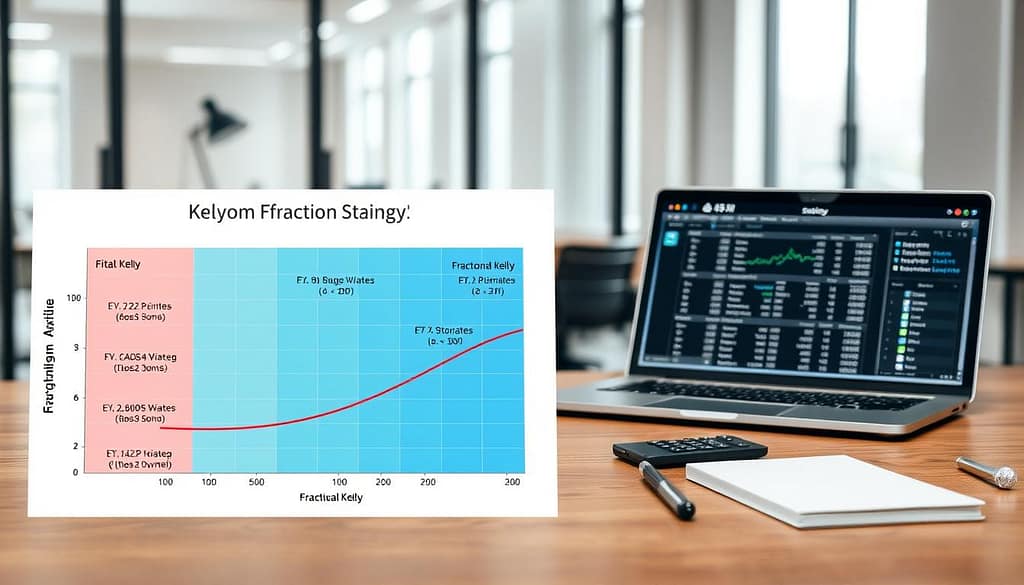
This is where the Kelly fraction comes in. Most pros don’t bet the full Kelly. Instead, they bet a fraction of it, like half (1/2), a third (1/3), or a quarter (1/4). This is the safe way to bet.
The adjusted formula is easy: Stake % = (EV / (Odds – 1)) * Your Chosen Fraction. If full Kelly says to bet 5% of your bankroll, half-Kelly suggests 2.5%.
This fraction helps control risk. It reduces the size of your bets. This makes big losses less likely.
Studies show a big difference. With full Kelly, you might lose half your bankroll about 10% of the time. But with half-Kelly, that chance drops to almost 1%. You give up some chance to win big for more safety.
| Kelly Fraction | Recommended Stake %* | Chance of Bank Halving | Growth Reduction vs. Full Kelly | Volatility Buffer |
|---|---|---|---|---|
| Full (1.0) | 5.0% | ~10% | 0% | Low |
| Half (0.5) | 2.5% | ~1% | ~25% | High |
| Quarter (0.25) | 1.25% | <0.5% | ~44% | Very High |
*Example assumes Full Kelly stake of 5%.
Choosing your Kelly fraction is a personal choice. If you’re more cautious or not sure about your edge, pick a smaller fraction. This is the heart of staking with EV/variance. You first figure out your edge (EV), then use a fraction to manage risk.
By using a fractional Kelly strategy, you protect yourself from mistakes. You know your models aren’t perfect. This careful approach is key for pros because it keeps your money safe during losing times.
The fractional method makes staking with EV/variance practical for everyday betting. It balances the need to grow your money with the need to keep it safe.
Portfolio View: caps per market/day, correlation awareness
Testing a staking plan isn’t just about one bet. It’s about managing risk across all bets. Smart bettors manage their bankroll like a portfolio. Each bet is balanced against others.
This mindset is key for long-term success. Even the best single-bet stakes can fail if overall risk isn’t managed.
Defining a clear unit size is essential. A unit is a fixed percentage of your bankroll, usually 1% to 2%. It helps standardize stakes across different sports and bet types.
Without a standard unit, “unit creep” can happen. This is when stakes grow after wins, changing your risk profile. A clear unit size prevents this.
With your unit size set, you need to set smart caps. The first is a per-market cap. This limits how many units you risk on a single event or prediction.
A common rule is to never stake more than 2 units on any bet. This stops overconfidence in a single bet. It forces diversification, even with strong edges.
The second cap is a daily exposure limit. This is your total risk budget for all bets in a day. Experts suggest risking no more than 5% to 7% of your bankroll daily.
If your unit is 1%, this means a maximum of 5 to 7 total units in play on any given day. This daily limit helps you handle natural variance across multiple bets.
Correlation awareness is also critical. Bets on related outcomes concentrate risk instead of spreading it.
For example, betting on a team’s moneyline and the game total “over” is often correlated. If the team wins in a high-scoring game, you win both. But if they lose in a low-scoring game, you lose both. Your risk is doubled.
You must adjust your staking for correlated bets. Here are simple guidelines:
- Identify correlated plays: Common pairs include a team spread and the moneyline, or a player prop and a team total.
- Reduce unit sizes: When betting two correlated outcomes, stake less on each. Instead of 1 unit each, you might use 0.6 units per bet.
- Apply a combined cap: Treat a group of correlated bets as a single “market” for your per-market cap. Your total stake on the group should not exceed your 2-unit limit.
Managing bets as a portfolio requires discipline. Define your unit size clearly. Set hard caps per market and per day. Always ask if your bets are independent or linked.
This systematic approach turns individual wagers into a controlled, sustainable strategy. It’s the final piece that connects precise single-bet staking to overall bankroll safety.
Drawdown rules and cool‑offs
Drawdown rules are like a safety net for your betting bankroll. They kick in to stop you from making rash decisions when things go wrong. A drawdown happens when you lose some of your capital. For a data bettor, this could mean dropping 20% of your starting bankroll.
Having set rules is key because losing streaks test your willpower. Without a plan, you might start making reckless bets. This increases your risk of ruin—the chance of losing all your betting money.

To protect yourself, you need two main rules. First, set a hard stop-loss level. For example, stop betting for the day, week, or month after losing 25% of your bankroll.
This rule helps keep your money safe. It’s your last line of defense against losing everything. Some bettors prefer a simpler rule, like stopping after losing 4 units.
The second rule is a cool-off period. It kicks in after a smaller loss. Its purpose is to prevent “tilt”—when emotions cloud your judgment.
A cool-off is a short break. You might take an hour or a day off. This lets your emotions calm down before you bet again.
A strategic reassessment is a longer break. It involves a deep dive into your strategy, edge, and market conditions. You need to check if your advantage is real before betting again.
By following these rules, discipline becomes a system. They safeguard your bankroll, so you can keep betting. Remember, your bankroll is money for betting, and these rules help it last.
Drawdown management isn’t about avoiding losses. It’s about surviving them. A strict protocol is the best way to manage the long-term risk of ruin.
Tracker: realized vs target volatility
Your staking plan needs constant checks. It’s not just about making money. You must watch your realized volatility.
Realized volatility shows the actual ups and downs of your daily earnings. It’s compared to your target volatility. Your target comes from your staking fraction and edge guesses in a staking with EV/variance setup.
A big gap means trouble. If your realized volatility is always higher than your target, it’s a warning sign. You might have guessed your edge too high or the bet variance too low.
Experts in betting and poker use this info. They check their results often to make sure their models work.
Make it a habit to check your numbers. Look at your metrics after a certain number of bets or when your bankroll changes by 25-33%. If realized volatility is too high, adjust. Lower your stake fraction or set tighter daily loss limits.
This approach makes your staking with EV/variance strategy better. It turns fixed rules into a flexible system. This protects your bankroll and helps it grow over time.