
Most bettors think winning is about picking more games correctly. It is not. The real edge comes from making bets that are worth more than they cost. That is where Expected Value, or EV, changes everything.
If you want to stop betting on vibes, hot takes, and “locks” from social media, start here. EV sports betting is the skill that separates people who hope from people who measure, track, and attack soft numbers. A bet can lose tonight and still be a smart wager. A bet can win tonight and still be a bad one. That single idea flips the whole game on its head, and once it clicks, you’ll never look at odds the same way again.
What Is Expected Value in Sports Betting?
Expected value sports betting is the process of asking one question before every wager: Is this bet worth its price?
That’s it. That’s the lens. Forget flashy picks for a second. Forget your favorite team. Forget the last result. EV tells you whether a bet should make money over a large sample, not whether it cashes today.
Think of it like buying sneakers to resell. If a pair costs you $100 and you can usually flip it for $130, that’s a good deal. If you pay $100 and can usually sell for $85, that’s a bad deal. Sports bets work the same way. The “price” is the odds. Your “resale value” is the true chance of the outcome happening.
So, what is EV in sports betting in plain English?
It’s the average amount you’d expect to win or lose if you placed the same bet at the same price over and over again.
A positive number means the bet is profitable in the long run. A negative number means it drains your funds over time.
That’s why positive EV betting matters so much. It shifts your focus away from short-term outcomes and points it toward long-term decision quality. Smart bettors don’t ask, “Will this team win?” They ask, “Are the odds better than the true risk?”
That tiny change in thinking is massive. It turns betting from guessing into analysis, from chasing into choosing, and from noise into numbers.
The EV Formula Explained Without the Confusion
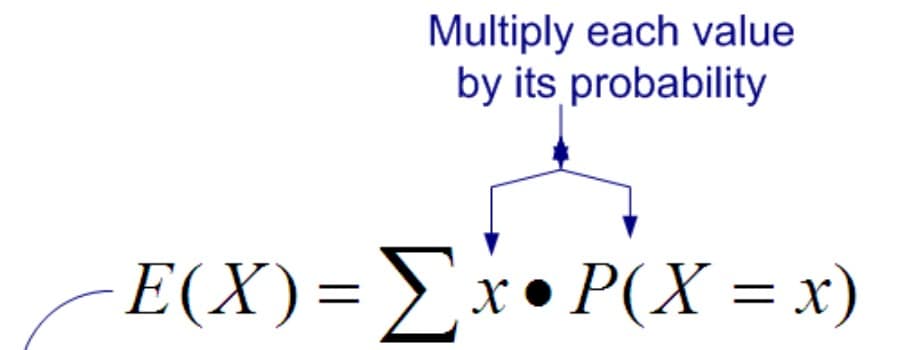
Here’s the formula:
EV = (Pwin × profit) − (Ploss × stake)
Looks stiff at first glance, right? It’s not. Break it into parts and it becomes easy.
Here’s what each piece means:
Pwin = your estimated probability that the bet wins
Profit = how much you win if the bet cashes
Ploss = your estimated probability that the bet loses
Stake = how much you risk
That’s all.
Let’s make it simple. You risk $100 on a bet that pays $150 in profit if it wins. After doing your homework, you think the bet wins 45% of the time. That means it loses 55% of the time.
Plug it in:
EV = (0.45 × 150) − (0.55 × 100)
EV = 67.50 − 55
EV = 12.50
That means your average return is +$12.50 per $100 bet over time.
Sounds simple, right? Here’s the catch: the formula is easy, but estimating the true win probability is where bettors make their money or lose their shirt. Anyone can type numbers into a sports betting expected value calculator. The skill is feeding it numbers that make sense.
Treat EV like a price-check tool. You walk into a store, see an item, and ask, “Is this overpriced or underpriced?” In sports betting, the sportsbook posts the number. Your job is to decide whether that number is off.
Master this, and betting odds and probability start making a lot more sense.
How to Calculate EV in Betting Step by Step
If you’re wondering how do you calculate expected value in sports betting, use this four-step process every time.
Start by converting odds into payout.
If you bet $100 at +150, your profit is $150 if the bet wins.
If you bet $100 at -120, your profit is $83.33 if the bet wins.
That profit number matters. EV depends on payout, not just win percentage.
Next, estimate the true probability. This is the hard part. You need your own estimate of how often the bet should win.
You can build that estimate from your own projections, team stats, injury news, matchup edges, market movement, historical trends used with care, and sharp price comparisons across books.
Let’s say a sportsbook offers +150 on a team. That line implies a win probability of around 40%. You look deeper and believe the team should win 45% of the time. That gap is where value lives.
Then plug the numbers into the formula:
EV = (Pwin × profit) − (Ploss × stake)
For a $100 stake at +150 with a 45% win probability:
Pwin = 0.45
Profit = 150
Ploss = 0.55
Stake = 100
EV = (0.45 × 150) − (0.55 × 100)
EV = 67.50 − 55
EV = 12.50
That gives you a positive result.
Now interpret the answer. Ask yourself: Is EV positive? Is my estimated probability realistic? Can I get a better number at another sportsbook?
If the EV is positive, you may have a bet worth taking. If it’s negative, pass and move on. No drama. No forcing action. No betting just to feel involved during the game, which is one of the fastest ways to torch your stack without realizing how bad your prices are.
A quick shortcut is implied probability. You should know implied probability sports betting basics if you want to spot value faster.
Use these quick formulas:
For positive odds: 100 / (odds + 100)
For negative odds: odds / (odds + 100)
Examples:
+150 = 100 / 250 = 40%
-120 = 120 / 220 = 54.55%
If your projected probability is higher than the implied probability, you may be looking at a +EV bet.
Real Example: Is This Bet Actually Worth Taking?
Let’s run through a real expected value example in betting.
A sportsbook posts Team A at +150.
You’re thinking about betting $100.
First, find the implied probability. +150 implies about 40%. So the market is saying Team A wins this game 4 times out of 10.
Next, build your own number. You look at the starting pitcher matchup, bullpen fatigue, weather, lineup splits, travel spot, and recent form without overreacting to it.
After your breakdown, you make Team A a 45% winner.
That may not sound like a huge gap. It is. Five percentage points can be gold if the price is right.
Now calculate the EV.
If you bet $100 at +150:
Profit if win = $150
Loss if lose = $100
Win probability = 45%
Loss probability = 55%
EV = (0.45 × 150) − (0.55 × 100)
EV = 67.50 − 55
EV = +12.50
That’s a positive EV betting spot.
What does that really mean?
It does not mean the bet wins tonight.
It means that if you could place this same wager hundreds of times at the same price with the same edge, you’d expect to make money over the long haul.
That’s the whole point.
Now flip the example. Say your true estimate is only 37%.
EV = (0.37 × 150) − (0.63 × 100)
EV = 55.50 − 63
EV = -7.50
That’s a negative EV bet. Avoid it.
This is where most casual bettors get trapped. They like the team. They saw a highlight. Their buddy likes the over. None of that answers the only question that matters: Is the price good enough?
What Is a Positive EV Bet?
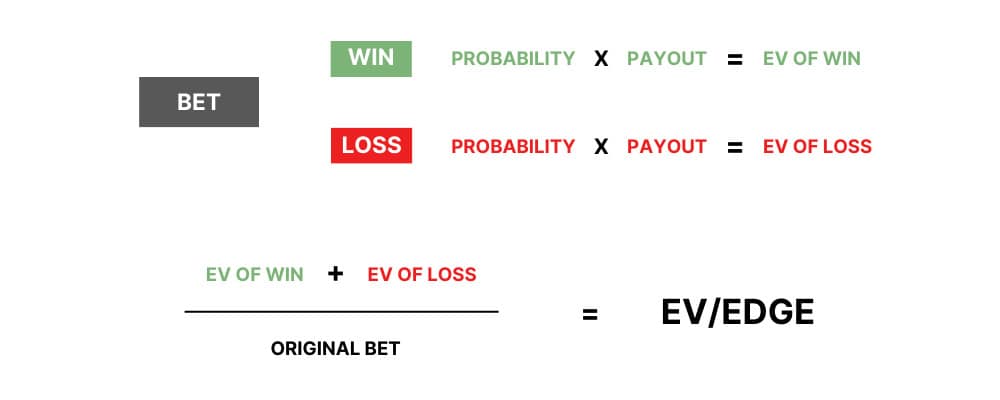
A positive EV bet is a wager where the payout is better than the actual risk.
That means the sportsbook’s line gives you more return than the true probability justifies.
In simple terms, you’re buying a dollar for eighty-five cents.
That doesn’t mean every +EV bet wins. Far from it. Some of your best bets will lose. Some ugly bets will cash. One result proves nothing. Sports are noisy. Variance is loud. A solid bet can still get buried by a bad bounce, a missed free throw, a bullpen collapse, or a garbage-time touchdown that blows up your number in the final minute after you handicapped the game well from every angle.
So why chase +EV bets?
Because long-term sports betting profit comes from repeated good decisions, not from trying to look smart on one slate.
Here’s the rule: Judge the bet by the number you got, not by the final score.
That mindset saves bettors from tilt, panic, and all the bad habits that come from living wager to wager.
Why Most Casual Bettors Place Negative EV Bets
Most people don’t lose at sports betting because they can’t pick a winner once in a while. They lose because they keep paying bad prices.
Here are the biggest traps.
Betting favorites blindly. Favorites win a lot. That’s why books charge more for them. A team can win often and still be a bad bet at the posted number.
Chasing parlays. Parlays are fun. Books know that. They often come with inflated hold and thin margins for the bettor. Hitting one feels amazing. Building a strategy around them usually burns your dough.
Betting with emotion. Your favorite team is not your business partner. Don’t let fandom turn a bad line into a must-bet.
Ignoring line value. A bettor grabs +130 at one app without checking another book that has +145. That difference may look small. Over months, it’s huge. Sportsbook odds comparison is not optional if you care about your bottom line.
Trusting public narratives. “Must-win game.” “They’re due.” “They always show up in primetime.” That stuff sounds sharp until you run the numbers.
Confusing recent results with true probability. A team covering three straight doesn’t mean the next number is cheap. Markets adjust. Books aren’t asleep.
Negative EV bets sneak up on people. They look fine on the surface. The team may even win. Yet if you keep taking bad prices, your bankroll management strategy won’t save you on its own.
How Sharp Bettors Identify +EV Opportunities
So how sharp bettors find value bets comes down to process. No magic. No mystery.
They line shop. This is step one. Always.
If one sportsbook has +140 and another has +155, grab +155 if you like that side. Better prices create better EV. Top sportsbooks for line shopping matter more than flashy promos if your goal is profit.
They compare implied probability to true probability. Sharps build or buy projections. Then they compare those projections against market odds. That’s where sports betting edge comes from.
They use numbers, not narratives. They look at player-level stats, pace, matchup splits, injury impact, rest edges, market timing, weather, and closing line movement.
They don’t bet stories. They bet prices.
They respect timing. Sometimes the best number appears early. Sometimes it shows up late. Sharp betting strategy includes knowing when the market is likely to move and why.
They track everything. Want to know if your reads are good? Track your bets. Record the open line, bet line, closing line, stake, expected value, and result.
That’s how you learn whether you’re beating the market or just guessing with better vocabulary.
They stay disciplined. No forced bets. No desperate recovery plays. No “I need action tonight” nonsense.
That discipline is what makes positive EV betting work in real life. The edge may be slim on many bets. You need volume, patience, and consistency to let it show up in your results.
Want to spot more +EV bets faster? Compare odds across top sportsbooks and claim the best available sign-up offers before placing your next wager.
Expected Value vs Win Rate: Which Matters More?
This is where newer bettors get tripped up.
A high win rate does not guarantee profit.
A lower win rate does not guarantee losses.
Let’s say Bettor A wins 65% of bets laying -200 over and over. Bettor B wins 45% of bets taking +150 prices with real value.
Who makes more?
Depends on the price.
That’s why expected value matters more than win rate. Win rate without context is just a shiny stat. It can fool you into thinking you’re crushing when you’re barely treading water, or worse, losing slowly.
Think of win rate like batting average. Nice to know. Not the whole story. EV is closer to return on investment. That’s the stat that tells you whether your approach has teeth.
A bettor can cash more tickets and still lose money. A bettor can hit fewer bets and stack profit by targeting plus-money spots with real edge.
So, what’s the bottom line?
Don’t chase being right. Chase being priced correctly.
That’s how profitable sports betting strategy actually works.
Common EV Mistakes Beginners Make
A lot of bettors learn the EV formula and think they’ve cracked the code. Then they trip over these mistakes.
Overestimating their edge. Everyone thinks their model is better than it is. Be tough on your numbers. If your projections are sloppy, your EV is fake.
Using bad assumptions. A number pulled from gut feel isn’t analysis. Build your probabilities from something real.
Ignoring variance. You can make good bets and still lose for weeks. That’s part of the deal. Don’t scrap a sound process after a rough stretch.
Confusing one result with long-term expectation. A losing +EV bet isn’t proof the bet was bad. A winning negative EV bet isn’t proof you found value.
Skipping line shopping. This mistake is brutal. The best way to calculate EV in sports betting starts with the best available number. A bad entry point ruins good analysis.
Betting markets you don’t understand. Don’t force action on props, alt lines, or niche markets just because the payout looks juicy. If you can’t price it, you can’t value it.
Master these leaks and you’ll avoid the mistakes that cost players money most often.
Tools That Make EV Betting Easier
You don’t need to do every calculation by hand.
A few tools can clean up your process: a sports betting expected value calculator for quick math, odds comparison tool sports betting platforms for line shopping, projection models for win probability estimates, bet tracking apps to log CLV, ROI, and stake size, and the best sports betting calculators for implied probability and payout checks.
If you’re serious about value betting explained in practical terms, start with two things: a calculator and a screen that shows multiple sportsbook prices.
That combo alone can level up your game fast.
And yes, promos matter when used smartly. A sportsbook sign up bonus or one of the best online sportsbook promos can add value to your account if the rollover terms make sense and you’re already planning to line shop there. Just don’t let a bonus trick you into betting bad numbers.
Use tools to sharpen your process, not replace it.
Final Takeaway: Think Like a Bettor With an Edge
Most bettors lose because they focus on picking winners instead of finding value. That’s the leak. Fix that, and your whole approach changes.
Expected value is the backbone of smart betting. It teaches you to think like an investor, not a gambler. That means pricing risk, comparing numbers, shopping lines, and making peace with the fact that a strong bet can still lose on any given night.
Here’s your next move:
Learn implied probability.
Use an EV calculator.
Compare prices across books.
Track your bets.
Judge decisions, not single outcomes.
Stop asking, “Who will win?”
Start asking, “Is this price worth it?”
That question is where real betting skill begins.
FAQs
1. Can you win sports betting with expected value alone?
EV gives you the framework for smart wagers, though you still need solid probability estimates, line shopping, bankroll control, and patience. The formula is the map. Your process is the vehicle.
2. What is a positive EV bet in sports betting?
A positive EV bet is a wager where the odds offer more return than the true probability of the event suggests. In short, the price is better than it should be.
3. Why expected value matters more than win rate?
Win rate ignores payout. A bettor can win often at bad prices and still lose money. EV bakes in both probability and profit, which makes it the sharper way to judge a bet.
4. How to compare sportsbook odds for EV?
Check the same market across multiple sportsbooks, convert the prices into implied probability, then compare those prices to your projected probability. The best number usually gives you the strongest EV.
5. What’s the easiest way to start using EV in sports betting?
Start simple. Use a sports betting expected value calculator, track a few markets you know well, compare prices across books, and log every bet. Keep your process tight, and let the sample size do the talking.