

Ever found a twenty-dollar bill on the sidewalk while everyone else argued about which side to walk on? That’s arbitrage betting in a nutshell.
Bookmakers sometimes can’t agree on reality. They create temporary windows where you can place wagers on all outcomes and guarantee profit regardless of who wins.
Think of it as the sports world’s version of buying low and selling high simultaneously. It requires Swiss watch timing and saint-like patience.
This strategy exploits those beautiful moments when combined probabilities across sportsbooks dip below 100%. It’s a mathematical anomaly in an industry built on ensuring the house always wins.
Smart bettors have turned this approach into their personal ATM. The secret lies in those fleeting discrepancies between oddsmakers.
The Science Behind Arbitrage
Arbitrage isn’t gambling—it’s a sure thing when bookmakers disagree. It’s like finding holes in the system where numbers don’t match. Even with protective margins, bookmakers sometimes make mistakes.
Every odd has an implied probability. To find this, divide 1 by the odds number. For example, a 2.0 odd means a 50% chance (1/2.0 = 0.50). Bookmakers add a margin to make sure they win, no matter what.
Now, the magic happens. If Bookmaker A offers a 2.1 odd (47.6% chance) and Bookmaker B offers the opposite at 2.1 (also 47.6%), their total is 95.2%. The missing 4.8% is your chance to make money. It’s a mathematical certainty that someone’s wrong, and you win.
These sure bets come from market flaws, not magic. It’s like two chess players making different moves for the same position. The smart bettor wins because someone made a mistake. The charm of arbitrage betting with Pinnacle is turning these disagreements into guaranteed wins.
Remember, bookmakers’ odds are just guesses in numbers. When their guesses don’t match, you win. It’s not magic—it’s just better math meeting a brief market mistake.
Finding “Sure Bets” Across Bookmakers
Imagine you’re a Wall Street expert now trading betting slips instead of stocks. You’re not just betting; you’re finding chances to make money from market mistakes. The goal is to spot when bookmakers don’t agree on the odds.
These chances come from “odds dissonance.” Sometimes, a sportsbook might not update fast after a big change. Or, they might offer special deals that change the odds. Big games like Premier League football or NBA games are best because there’s more action and disagreement.
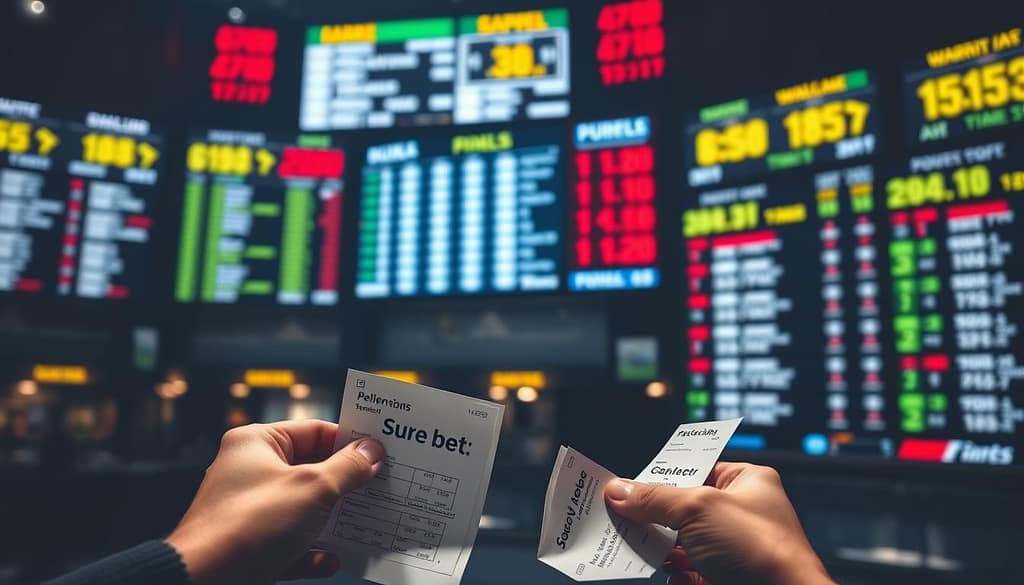
The key is in hedging across different markets. You might see different odds for the same game. It’s like playing a game of chess, where you use different moves to outsmart your opponent.
To succeed, you need to watch many platforms at once. These chances can disappear quickly. That’s why experts use special software to scan many markets fast.
| Opportunity Type | Typical Duration | Profit Margin Range | Monitoring Difficulty |
|---|---|---|---|
| Bookmaker Disagreement | 2-15 minutes | 1-3% | Moderate |
| Promotional Offers | 5-30 minutes | 3-8% | Easy |
| Slow Odds Updates | Seconds to 2 minutes | 2-5% | High |
| Cross-Market Hedging | 1-10 minutes | 1-4% | Expert |
The table shows that quick action is key. A tempting offer might disappear before you can act. So, it’s important to be fast.
Hedging is about finding chances worth the effort. It’s like watching stock prices, learning which bookmakers are slow and when to bet. This way, you can make the most of your time.
Calculating Profit Margin
Time to put on our accounting hats and figure out what makes a difference between break-even and actual earnings. It’s not rocket science—it’s basic math that sets pros apart from hobbyists.
The key is implied probability: 1 divided by decimal odds. For our tennis example, Player A at 1.80 gives us 55.56% chance, and Player B at 2.40 gives 41.67%. Together, they add up to 97.23%. That 2.77% is your profit margin.
Now, let’s talk money: bet $55.56 on Player A and $41.67 on Player B. Your total stake is $97.23. If Player A wins, you get $100.01. If Player B wins, you also get $100.01. Either way, you make a $2.78 profit.
That 2.8% margin might seem small, but in arbitrage, it’s huge. It’s the difference between winning and losing. These margins are very thin, like finding a twenty-dollar bill in last season’s jacket.
The real skill is in being precise. If you round up to $56 and $42, your profit becomes a hope. This math turns gambling into smart investing, one decimal at a time.
Risks, Limitations & Bookie Reactions
Let’s talk about the casino’s house rules – because even sure bets come with fine print thicker than a Tolstoy novel. Sportsbooks use surveillance systems that make Orwell’s Big Brother look like a casual observer. They track betting patterns with NSA-level precision, hunting for arbitrage activity like bloodhounds on a scent.
Get flagged by these systems, and you’ll experience what I call “financial suffocation.” First comes stake limitation – suddenly your $500 bets become $5 wagers. Then account closures arrive faster than a politician’s broken promise. Some books simply show you the digital exit door without explanation.
Timing becomes your worst enemy in this high-stakes game. Odds can shift between spotting an opportunity and placing your second bet. You might secure one side at 2.10 only to find the other side has dropped to 1.90, turning your calculated advantage into immediate loss.
Bookmakers practice defensive odds alignment with terrifying efficiency. They monitor competitors and adjust lines faster than social media trends change. This coordinated movement eliminates price discrepancies before most arbers can capitalize.
Buried in those terms and conditions you never read? Language specificallly prohibiting arbitrage betting. Most platforms reserve the right to void bets and confiscate winnings if they suspect arbing activity. It’s their house, their rules – and they rewrite them constantly.
| Bookmaker Reaction | Impact on Arber | Likelihood | Countermeasure |
|---|---|---|---|
| Stake Limitations | Reduced profit potencial | High | Multiple accounts |
| Account Closure | Complete access loss | Medium | Stealth betting patterns |
| Odds Alignment | Fewer opportunities | Very High | Faster execution |
| Bet Voiding | Total loss | Low | Understanding T&Cs |
Despite these challenges, many successful arbers continue finding opportunities through careful strategy and proper bankroll management. The key lies in understanding that while arbing offers mathematical advantages, it operates in an ecosystem actively working against it.
Smart arbers treat this as a marathon, not a sprint. They maintain multiple accounts across different jurisdictions. They vary betting patterns to avoid detection. Most importantly, they never risk more than they can afford to lose – because even sure bets carry uncertainty when bookmakers change the rules mid-game.
Tools for Arbing
You wouldn’t bring a butter knife to a gunfight, and you shouldn’t approach arbitrage betting with just a lucky rabbit’s foot. The modern arber’s arsenal looks less like a sports fan’s weekend setup and more like a Wall Street quant’s trading desk.
Odds comparison websites serve as your radar system—constantly scanning hundreds of markets across dozens of bookmakers. They’re the digital equivalent of having eyes everywhere at once. These platforms do the heavy lifting of finding those precious price discrepancies that make arbitrage possible.
Then comes the navigator: arbitrage calculators. These clever tools tell you exactly how much to wager on each outcome to lock in profits. They transform complex probability math into simple betting instructions. It’s like having a financial advisor whispering in your ear.
The serious hardware? Dedicated arbitrage software that identifies opportunities faster than humanly possible. Some even place bets automatically, though that ventures into ethically murky waters. It’s the difference between driving a family sedan and piloting an F1 car.
VPNs become your passport to opportunity. They bypass geo-restrictions to access international bookmakers, expanding your playing field globally. Just remember—while tools enable advanced hedging strategies, they can’t read terms of service or spot when a bookmaker’s about to limit your account.
| Tool Type | Primary Function | Importance Level |
|---|---|---|
| Odds Comparison Sites | Market scanning | Essential |
| Arbitrage Calculators | Stake calculation | Critical |
| Betting Software | Opportunity identification | Advanced |
| VPN Services | Geo-restriction bypass | Situational |
| Community Forums | Information sharing | Highly Valuable |
Don’t underestimate the human element. Forums and communities serve as intelligence networks where sharp bettors share insights like Cold War spies exchanging coded messages. These communities often spot market trends before the algorithms do.
The truth? Tools amplify your capabilities but don’t replace judgment. The best software can’t read between the lines of bookmaker policies or sense when the market’s about to shift. That’s where your brain becomes the most valuable tool in your hedging arsenal.
Remember: technology enables the strategy, but you’re the pilot. Choose your tools wisely, but trust your instincts more. After all, even the best radar system can’t tell you when to avoid the storm—only how to navigate through it.
Conclusion
Arbitrage betting is not a quick way to make money. It’s a complex game against smart bookmakers. You need quick hands, sharp thinking, and perfect math every time.
Bookmakers keep an eye on arbitrage players. They limit accounts that win too much. To avoid detection, bet small and spread your bets across different sites. Don’t just go for the biggest arbitrage odds you see.
This strategy requires discipline. Treat your bankroll seriously, like an investor. Use tools to find opportunities before others do. The market changes fast.
Winning at arbitrage is a quiet achievement. It’s based on precision, not luck. For skilled bettors, it turns sports betting into a numbers game. And in that game, the math always prevails.